
As an athlete, you need to find a game day routine that works for you.
You want to be mentally prepared so you can reliably and repeatedly achieve peak performance.
Unfortunately, many athletes end up mentally burnt out by game time, while others are not prepared enough and start the game off too tense, too casual, or just flat out too slow.
The Sweet Spot
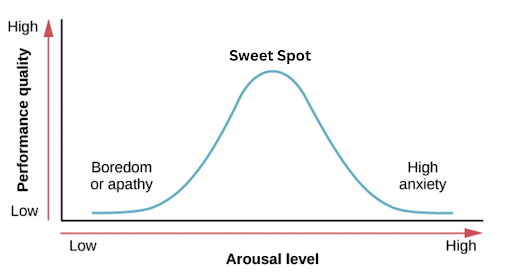
The goal is to start your game off in the sweet spot – relaxed yet focused.
This is best described with Optimal Arousal Theory – which originated in 1908 by psychologists Robert Yerkes and John Dodson (diagram below).
If your arousal level is too high – you are too amped up – you end up too tense and under performing.
If you overcompensate and play it too cool, you end up lacking focus.
Everyone’s sweet spot is unique to them, so don’t copy someone else’s. Find out what your sweet spot is, then build your game day routines to help you reliably get there every day.
Here are the top 10 do’s and do not’s of game day routines so that you can be mentally prepared to achieve Consistent Elite Performance:
1. Do Not Overthink
Too many athletes overthink about the game. By game time they have played the game in their head multiple times and are mentally burnt out. Click here to check out how you can prevent overthinking by thinking differently.
2. Do Not Overuse Social Media
Too much time on your phone or on social media can clutter your mind with junk. Take control of your phone and learn how to protect your mind from the mental junk.
3. Do Not Obsess about Results
Most athletes get consumed by results. They try to predict the outcomes and engage in unhealthy comparisons with others. This is the number one mental block holding athletes back. Click here to learn about how you can stop obsessing about results by embracing the power of acceptance.
4. Do Not Use Superstitions
Rituals and routines are helpful as you will see below. But the problem with superstitions is when you think doing x causes y and then one day you can’t do x – then your whole game gets thrown off.
5. Gradual Build Up
Plan the segments of your day so that you are not under or over stimulated. Use the following list of do’s to help build your game day routine. See the diagram at the bottom for the final product.
6. Relax
Intentionally unplug and relax. Spend time thinking and doing other things outside of your sport. You can’t spend your whole day obsessing about your sport – you will mentally burn yourself out. Music is also a great way to help relax. You should intentionally choose the music in your pre-game routine to help you gradually build up to your optimal level of arousal.
7. Prepare & Prime Your Body
Sleep, exercise, and nutrition. Foremost is sleep – it starts days before, not just the night before. Planning for a nap is a common and effective strategy. You also want to get active during the day – don’t be sedentary all day. Figure out your optimal pregame mobility & activation exercises, as well as the technical drills to help you get into the feel of the game. You should also know what and when you are eating on game days.
8. Visualization
10 minutes of visualizing your personalized imagery script is a fundamental mental preparation strategy. We recommend doing this about 3 hours to 30 minutes before game time. Click here to learn 5 key tips to effective visualization.
9. Reset Routine
You may have other rituals that help you get into your optimal state, but the fundamental strategy that we use with athletes is the Reset Routine. It provides a reliable and repeatable way to tap into your sweet spot before game time. Learn more about how you can block out the noise with a Reset Routine by clicking here.
10. Post-Game Routine
This matters for multiple reasons. Foremost you want to be able to effectively process the game – regardless of the result. You own the success and learn from the challenges. This is the perfect time to use the Personal Scorecard strategy and reflect on things within your control. It’s also important to learn how to decompress and relax so you can get to sleep. Many sports require quick turnaround times with back to back games. Check out our top relaxation techniques here.
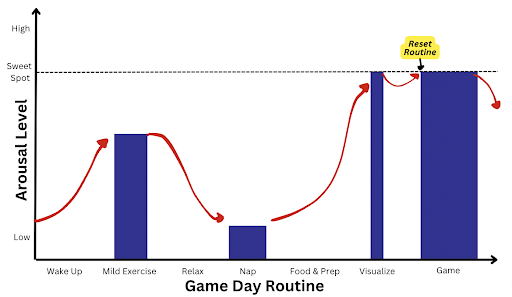
In summary, you need to create a game day routine so you can reliably and repeatedly get into your sweet spot and start your games off on the right track.
I hope you found this helpful.
Please share this with anyone you think would benefit from this post.
 Nicholas Santino is a Senior High-Performance Coach, PhD Candidate, and the official Mental Performance Consultant for Elite Prospects. From his specialized psychology research program, to his PhD studies, Nicholas has gained a tremendous foundation of knowledge and appreciation for the human experience. His passion for psychology has accumulated to a commitment to studying and applying positive psychology and stoicism. This commitment has led Nicholas to conduct many research studies focusing on understanding why and how some people thrive and prosper while others do not. His admiration for evidence-based solutions has propelled Nicholas to produce studies revolving around mindfulness, grit (perseverance and passion), performance, quality participation, social relationships, and well-being.
 A Native of Quebec, Sara was part of the St. Lawrence University Women’s Ice Hockey team that competed in the NCAA Division 1 hockey league ECAC. During this time, Sara helped her team appear in four ECAC Hockey Tournaments and two NCAA Frozen Fours, and was a four-time member of the ECAC Hockey All-Academic Squad. Following her career at St. Lawrence University, Sara played one year of professional hockey with Lugano, where she truly honed her skills in understanding the intricate connection between mindset and performance.
 Blair has over 13 years of experience as a Professional Dancer, Assistant Dance Captain & Cast Manager, as well as an additional 17 years of training. Over the last 3 decades, she has lived and experienced first hand the highest of highs & lowest of lows that come with pursuing a career in the Performing Arts.

 Natasha Habert draws from her training in sport and performance psychology, personal experiences as a competitive athlete, and deep passion for consistent high performance. She is a lifelong athlete and high performer, excelling in volleyball as both a player and coach.
 Luciano’s hockey career is highlighted by his time playing college at the University of Victoria and two professional seasons in Europe. Throughout his career, he struggled with performance anxiety, a lack of consistency, fluctuations in confidence, being caught in the results trap. This eventually led him to deviate from the main reason why anyone should play sports – for the enjoyment of the game. As a former athlete, Luciano has a unique understanding of the psychological pressures and struggles that athletes experience.
 Alexis is a professional female hockey player, Kaizen Sports representative, and former NCAA athlete who brings a wealth of knowledge and experience to our athletes. At a young age she allowed external factors to influence her game, resulting in her struggling to find confidence and consistency on the ice. As she began climbing the ranks as an athlete, she quickly realized that her confidence and mental toughness needed to be developed to compete at the highest level. As a professional athlete she has now developed a passion to help other athletes master their performance and excel on their journey through sport.
 Sean Mahoney is a member of the Association for Applied Sport Psychology (AASP), and a Master’s candidate in the Sport and Performance Psychology program at the University of Denver. For as long as he can remember, Sean has been fascinated by human performance and how to gain an edge over the competition. For most of his athletic career, he focused on the physical aspect of performance but neglected the mental. Because of this, he struggled with performance anxiety, focus issues, and limiting beliefs pertaining to confidence and self-doubt. His lack of focus on optimizing his mental game prevented him from reaching his full potential.
 Savannah Fitzgerald is earning her M.A. in Kinesiology, Sport Psychology Option at California State University, Fresno. Possessing an internal motor that fires her rage for success, Savannah forged this attribute over five years while competing as an NCAA D-I water polo player and swimmer. Combined with her opportunity to represent and compete for the United States, she feels that sport has significantly impacted her professional development. Due to her personal experience playing at all levels, Savannah’s passion for mental performance began when she struggled to overcome pre-competition nerves and post-competition processing. When she discovered a world out there that people were referring to as ‘sport psychology,’ she felt like a piece of her brain was unlocked. Reality shifted as she stumbled into a space consisting of the most beautiful blend of elite performance, mental well-being, and athletics.
 Gabe is currently majoring in Psychology with a minor in Counselling Psychology at the University of British Columbia in Vancouver. With an interest in high-level baseball and soccer, Gabe ended up focusing on hockey. Most recently, Gabe played four years of junior hockey with the Richmond Sockeyes in the Pacific Junior Hockey League (PJHL) while also coaching minor hockey. Prior to junior hockey, Gabe played 3 years in the Canadian Sport School Hockey League (CSSHL) where he experienced the pressures and expectations of moving on to the next level. During those three years, Gabe constantly compared himself to others and struggled with coping when things did not go his way. Over time, he learned how to focus on his own process and path to the next level, while also developing strategies to improve well-being.
 Louie is a mental performance coach from Toronto, Canada with a professional hockey career spanning over 14 years. Being a standout player at the University of Michigan, Louie was a Hobey Baker finalist and a 1st team All-American, which led him to getting drafted by the Ottawa Senators and playing in renowned leagues across the globe, including the DEL, SHL, and AHL.
 Mia Landry is a former varsity hockey player at Brock University, where she competed at the USPORT level and was part of the 2021-22 OUA gold medal team. Mia currently represents Canada on the Women’s National Ball Hockey team and is pursuing a Master of Kinesiology Sport Psychology at her alma mater. Her research focuses on areas such as team cohesion, group dynamics, leadership styles, and sports culture.
 As a former member of McMaster University’s women’s soccer team, Emilie intimately understands the demands and challenges athletes face on and off the field. Although she encountered many challenges as a high-level athlete, particularly struggling with self-doubt and overthinking, Emilie was able to make a remarkable transformation when she began to embrace the principles of sports psychology.
 Max is currently attending William James College, where he is earning a Doctorate Degree in Clinical Psychology and a Masters Degree in Professional Psychology. During his time as an undergraduate student, Max was inducted into the International Honor Society in Psychology (Psi Chi), and played on the Quinnipiac University men’s club ice hockey team.