
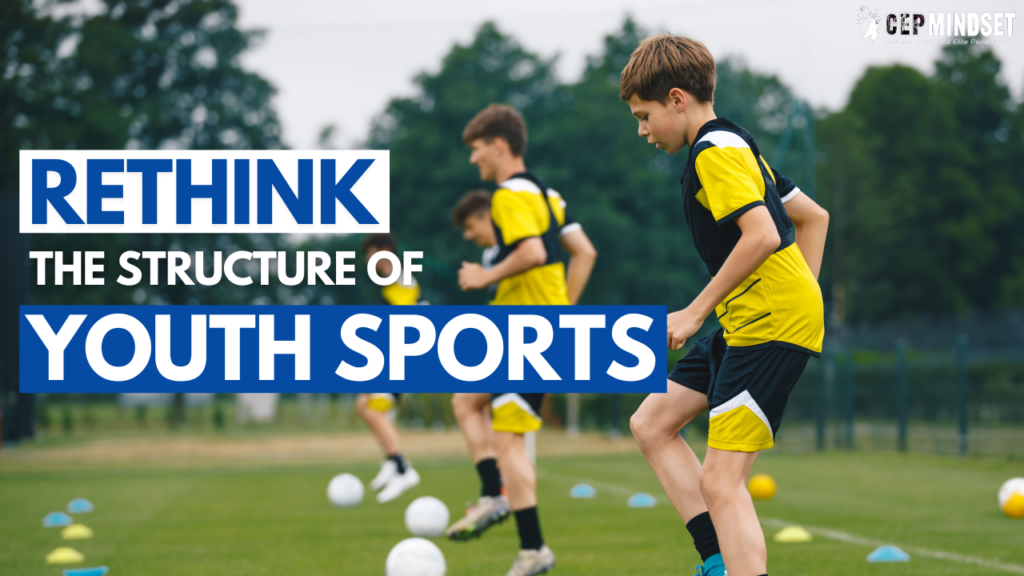
I want to challenge you to think differently about the youth sporting structure.
Specifically, I want to share one unique insight from Serena and Venus Williams’ rise to dominance in the Tennis world.
If you haven’t seen the movie King Richard – this is a slight spoiler on the movie. The insight I want you to reflect on is how their dad pulled Venus out of junior competitions at 12 years old after going 63-0 in junior tournaments. For the next 3 years Venus and Serena focused on training and having a more ‘normal’ childhood focused on school, family, and being a kid.
Their father, Richard, felt that all the tournaments they were going to were not helpful to their character development and the ‘pressure’ was unnecessary at such a young age.
This unconventional decision obviously worked out pretty good for them.
It is a great example of thinking differently about the youth sport structure. He decided to not just go with the status quo. To me this is inspiring and revolutionary – it was a mindset first decision.
I’d be curious to see a 12 year old hockey player give up formal games and tournaments for 3 years – just focus on development (and save all the money and time traveling to games).
They could still scrimmage, play small area games, and learn fundamental team concepts. But the priority would be getting their touches in and optimizing their development.
I wonder what the impact on the players’ mental well-being and character development would be?
There is a ridiculous amount of pressure to perform and win on most AAA minor hockey teams and youth sports in general.
I’m not saying this is an obvious or easy decision. Instead, I’m using the contrast to encourage players, parents, coaches, and leaders throughout the game to be mindful of the structure and environment of youth sports. I challenge you to think differently – don’t just accept the status quo.
 Nicholas Santino is a Senior High-Performance Coach, PhD Candidate, and the official Mental Performance Consultant for Elite Prospects. From his specialized psychology research program, to his PhD studies, Nicholas has gained a tremendous foundation of knowledge and appreciation for the human experience. His passion for psychology has accumulated to a commitment to studying and applying positive psychology and stoicism. This commitment has led Nicholas to conduct many research studies focusing on understanding why and how some people thrive and prosper while others do not. His admiration for evidence-based solutions has propelled Nicholas to produce studies revolving around mindfulness, grit (perseverance and passion), performance, quality participation, social relationships, and well-being.
 A Native of Quebec, Sara was part of the St. Lawrence University Women’s Ice Hockey team that competed in the NCAA Division 1 hockey league ECAC. During this time, Sara helped her team appear in four ECAC Hockey Tournaments and two NCAA Frozen Fours, and was a four-time member of the ECAC Hockey All-Academic Squad. Following her career at St. Lawrence University, Sara played one year of professional hockey with Lugano, where she truly honed her skills in understanding the intricate connection between mindset and performance.
 Blair has over 13 years of experience as a Professional Dancer, Assistant Dance Captain & Cast Manager, as well as an additional 17 years of training. Over the last 3 decades, she has lived and experienced first hand the highest of highs & lowest of lows that come with pursuing a career in the Performing Arts.

 Natasha Habert draws from her training in sport and performance psychology, personal experiences as a competitive athlete, and deep passion for consistent high performance. She is a lifelong athlete and high performer, excelling in volleyball as both a player and coach.
 Luciano’s hockey career is highlighted by his time playing college at the University of Victoria and two professional seasons in Europe. Throughout his career, he struggled with performance anxiety, a lack of consistency, fluctuations in confidence, and being caught in the results trap. This eventually led him to deviate from the main reason why anyone should play sports – for the enjoyment of the game. As a former athlete, Luciano has a unique understanding of the psychological pressures and struggles that athletes experience.
 Alexis Woloschuk is a name synonymous with mental fortitude in the world of professional hockey. Throughout her career originating playing boys hockey, going to an academy away from home, playing her four years at Boston University and 7+ years in pro hockey she’s learned the importance of resilience, confidence, and dismissing both fear and other’s opinions. With a blend of relatability, confidence, and an acute understanding of playing to one’s potential, Alexis helps athletes reshape the way they perceive and harness the power of their minds.
 Sean Mahoney is a member of the Association for Applied Sport Psychology (AASP), and a Master’s candidate in the Sport and Performance Psychology program at the University of Denver. For as long as he can remember, Sean has been fascinated by human performance and how to gain an edge over the competition. For most of his athletic career, he focused on the physical aspect of performance but neglected the mental. Because of this, he struggled with performance anxiety, focus issues, and limiting beliefs pertaining to confidence and self-doubt. His lack of focus on optimizing his mental game prevented him from reaching his full potential.
 Savannah Fitzgerald is earning her M.A. in Kinesiology, Sport Psychology Option at California State University, Fresno. Possessing an internal motor that fires her rage for success, Savannah forged this attribute over five years while competing as an NCAA D-I water polo player and swimmer. Combined with her opportunity to represent and compete for the United States, she feels that sport has significantly impacted her professional development. Due to her personal experience playing at all levels, Savannah’s passion for mental performance began when she struggled to overcome pre-competition nerves and post-competition processing. When she discovered a world out there that people were referring to as ‘sport psychology,’ she felt like a piece of her brain was unlocked. Reality shifted as she stumbled into a space consisting of the most beautiful blend of elite performance, mental well-being, and athletics.
 Gabe is currently completing his Master’s in Counselling Psychology at the University of Victoria. Although Gabe played several years of high-level baseball, including a stint in the British Columbia Premier Baseball League (BCPBL), he chose hockey as his sport to pursue at the highest level possible. Gabe went on to play four years of junior hockey with the Richmond Sockeyes in the Pacific Junior Hockey League (PJHL) while also coaching minor hockey. Prior to junior hockey, Gabe played 3 years in the Canadian Sport School Hockey League (CSSHL) where he experienced the pressures and expectations of moving on to the next level. During those three years, Gabe constantly compared himself to others and struggled with coping when things did not go his way. Over time, he learned how to focus on his own process and path to the next level, while also developing strategies to improve well-being.
 Louie is a mental performance coach from Toronto, Canada with a professional hockey career spanning over 14 years. Being a standout player at the University of Michigan, Louie was a Hobey Baker finalist and a 1st team All-American, which led him to getting drafted by the Ottawa Senators and playing in renowned leagues across the globe, including the DEL, SHL, and AHL.
 Mia Landry is a former varsity hockey player at Brock University, where she competed at the USPORT level and was part of the 2021-22 OUA gold medal team. Mia currently represents Canada on the Women’s National Ball Hockey team and is pursuing a Master of Kinesiology Sport Psychology at her alma mater. Her research focuses on areas such as team cohesion, group dynamics, leadership styles, and sports culture.
 As a former member of McMaster University’s women’s soccer team, Emilie intimately understands the demands and challenges athletes face on and off the field. Although she encountered many challenges as a high-level athlete, particularly struggling with self-doubt and overthinking, Emilie was able to make a remarkable transformation when she began to embrace the principles of sports psychology.
 Max is currently attending William James College, where he is earning a Doctorate Degree in Clinical Psychology and a Masters Degree in Professional Psychology. During his time as an undergraduate student, Max was inducted into the International Honor Society in Psychology (Psi Chi), and played on the Quinnipiac University men’s club ice hockey team.