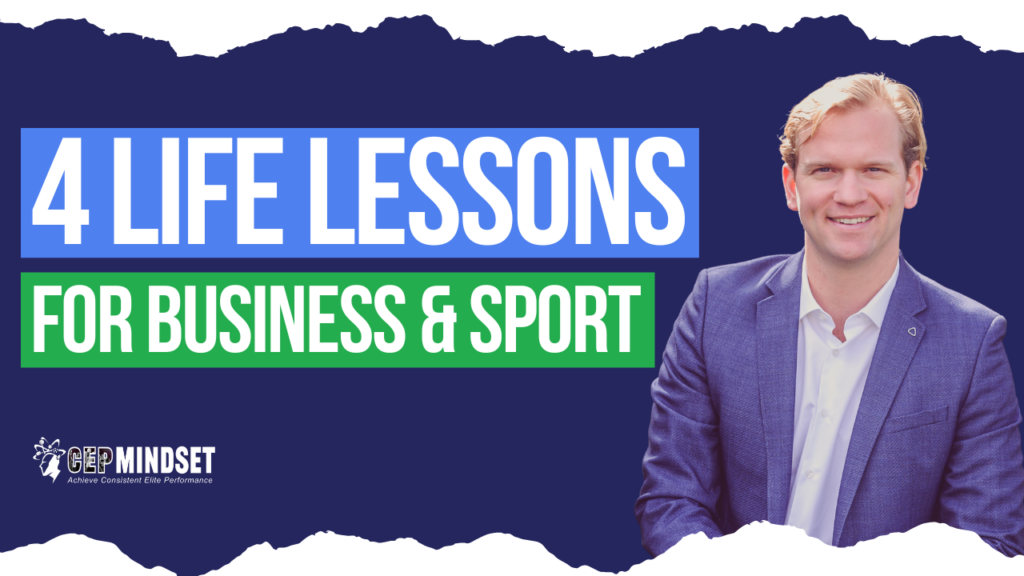
I (Dr. Cassidy Preston) started hockey when I was 2 years old.
Since then I’ve…
• Played 10 years of juniors, college, and pro hockey
• Spent 12 years in University to earn my PhD
• Built one of the Largest Mental Performance Coaching Firms in North America
Here are the 4 biggest lessons I’ve learned:
LESSON 1: Stay Connected to the Love of the Game
As a hockey player I got caught in the results trap over and over again.
I was obsessed with points and worried about what others thought (e.g. coaches, parents, teammates, scouts).
But this caused a slew of challenges.
I had yo-yo confidence as I tied my confidence to results.
I got anxious and held my stick too tight – worrying about results.
I struggled with resilience – I’d beat myself up and go into downward spirals after negative results.
The mistake was confusing my goals to achieve x, y & z results with my why.
Why you play the game is not the results.
Why you play the game is about the intrinsic drivers:
- Growth
- Experience
- Connections
This is the key to enjoying the journey of sport & life.
LESSON 2: Be Patient, Adaptable, & Creative
I’ve naturally been prone to:
- Rush to achieve results
- Stubbornly stick to a plan
- Think logically about solutions
These traits have their benefits and have served me well.
But they can also be very costly.
I’ve intentionally become more patient, adaptable and creative.
Without a doubt these traits have been invaluable to my success as an entrepreneur.
When my clients integrate these traits into their mental preparation – I see the profound impact it has on their athletic careers.
Looking back I would have benefited as an athlete from being more:
- Patient with my career
- Adaptable based on my results and feedback from coaches
- Creative with how I mentally prepared and played the game
The magic lies within finding the balance between being:
- Patient and Eager
- Adaptable and Relentless
- Creative and Logical
LESSON 3: Embracing the Power of No
Ambitious people love to say yes, but this can lead to being overwhelmed and being scattered.
We end up focusing and working on things that are NOT the top priority.
We lose sight of what matters most because we end up chasing all the shiny objects.
Flow is the result of finding the right balance between challenge and capabilities.
When we are stressed and overwhelmed, we have too many challenges to overcome.
We have said YES too much.
We are focusing on too many things.
The solution to get back to flow is to say No!
As an athlete this is often about simplifying your priorities. Get a clear game plan that is practical and personalized for you. I see the benefits athletes get from doing this daily.
Personally, this is the most impactful lesson I’ve had as an entrepreneur.
I used to have 5 or more projects on the go – juggling from task to task.
Now I focus on 1 priority at a time, get 1 project done, then move to the next one.
Building momentum 1 thing at a time.
LESSON 4: Build Your Team
Being a lone wolf was a mentality that I often prided myself on.
I thought figuring out things on my own was the key to achieving success.
It’s funny, in school we are often taught to not copy others’ work.
But in the real world if someone has a good idea, strategy, or habit we don’t need to reinvent the wheel – just do what works.
Then give credit where credit is due.
For example as a hockey player – Matt Marquardt was a peer with a bullet of a shot. So one day I stopped trying to figure out how to make my shot better on my own. The tips he gave me made my shot significantly better in days.
My only regret is not asking him for tips sooner!
Another example in business, I give a lot of credit to Todd Herman & his 90 Day Year System for helping with Lesson 3 – Embracing the Power of No.
I am fortunate for all the other great teachers, mentors, coaches, and friends that have been invaluable guides in my journey.
Every great achievement in sport, business or life is the accumulation of a team of people utilizing their strengths.
So my reminder to you is to continually surround yourself with a great team of coaches, guides, and friends.
In summary – the 4 lessons are:
- Stay Connected to the Love of the Game
- Be Patient, Adaptable, & Creative
- Embrace the Power of No
- Build Your Team
They are key principles to success in sport, business and life.
I hope you found this helpful.
Please share with anyone you think would benefit.
 Nicholas Santino is a Senior High-Performance Coach, PhD Candidate, and the official Mental Performance Consultant for Elite Prospects. From his specialized psychology research program, to his PhD studies, Nicholas has gained a tremendous foundation of knowledge and appreciation for the human experience. His passion for psychology has accumulated to a commitment to studying and applying positive psychology and stoicism. This commitment has led Nicholas to conduct many research studies focusing on understanding why and how some people thrive and prosper while others do not. His admiration for evidence-based solutions has propelled Nicholas to produce studies revolving around mindfulness, grit (perseverance and passion), performance, quality participation, social relationships, and well-being.
 A Native of Quebec, Sara was part of the St. Lawrence University Women’s Ice Hockey team that competed in the NCAA Division 1 hockey league ECAC. During this time, Sara helped her team appear in four ECAC Hockey Tournaments and two NCAA Frozen Fours, and was a four-time member of the ECAC Hockey All-Academic Squad. Following her career at St. Lawrence University, Sara played one year of professional hockey with Lugano, where she truly honed her skills in understanding the intricate connection between mindset and performance.
 Blair has over 13 years of experience as a Professional Dancer, Assistant Dance Captain & Cast Manager, as well as an additional 17 years of training. Over the last 3 decades, she has lived and experienced first hand the highest of highs & lowest of lows that come with pursuing a career in the Performing Arts.

 Natasha Habert draws from her training in sport and performance psychology, personal experiences as a competitive athlete, and deep passion for consistent high performance. She is a lifelong athlete and high performer, excelling in volleyball as both a player and coach.
 Luciano’s hockey career is highlighted by his time playing college at the University of Victoria and two professional seasons in Europe. Throughout his career, he struggled with performance anxiety, a lack of consistency, fluctuations in confidence, being caught in the results trap. This eventually led him to deviate from the main reason why anyone should play sports – for the enjoyment of the game. As a former athlete, Luciano has a unique understanding of the psychological pressures and struggles that athletes experience.
 Alexis is a professional female hockey player, Kaizen Sports representative, and former NCAA athlete who brings a wealth of knowledge and experience to our athletes. At a young age she allowed external factors to influence her game, resulting in her struggling to find confidence and consistency on the ice. As she began climbing the ranks as an athlete, she quickly realized that her confidence and mental toughness needed to be developed to compete at the highest level. As a professional athlete she has now developed a passion to help other athletes master their performance and excel on their journey through sport.
 Sean Mahoney is a member of the Association for Applied Sport Psychology (AASP), and a Master’s candidate in the Sport and Performance Psychology program at the University of Denver. For as long as he can remember, Sean has been fascinated by human performance and how to gain an edge over the competition. For most of his athletic career, he focused on the physical aspect of performance but neglected the mental. Because of this, he struggled with performance anxiety, focus issues, and limiting beliefs pertaining to confidence and self-doubt. His lack of focus on optimizing his mental game prevented him from reaching his full potential.
 Savannah Fitzgerald is earning her M.A. in Kinesiology, Sport Psychology Option at California State University, Fresno. Possessing an internal motor that fires her rage for success, Savannah forged this attribute over five years while competing as an NCAA D-I water polo player and swimmer. Combined with her opportunity to represent and compete for the United States, she feels that sport has significantly impacted her professional development. Due to her personal experience playing at all levels, Savannah’s passion for mental performance began when she struggled to overcome pre-competition nerves and post-competition processing. When she discovered a world out there that people were referring to as ‘sport psychology,’ she felt like a piece of her brain was unlocked. Reality shifted as she stumbled into a space consisting of the most beautiful blend of elite performance, mental well-being, and athletics.
 Gabe is currently majoring in Psychology with a minor in Counselling Psychology at the University of British Columbia in Vancouver. With an interest in high-level baseball and soccer, Gabe ended up focusing on hockey. Most recently, Gabe played four years of junior hockey with the Richmond Sockeyes in the Pacific Junior Hockey League (PJHL) while also coaching minor hockey. Prior to junior hockey, Gabe played 3 years in the Canadian Sport School Hockey League (CSSHL) where he experienced the pressures and expectations of moving on to the next level. During those three years, Gabe constantly compared himself to others and struggled with coping when things did not go his way. Over time, he learned how to focus on his own process and path to the next level, while also developing strategies to improve well-being.
 Louie is a mental performance coach from Toronto, Canada with a professional hockey career spanning over 14 years. Being a standout player at the University of Michigan, Louie was a Hobey Baker finalist and a 1st team All-American, which led him to getting drafted by the Ottawa Senators and playing in renowned leagues across the globe, including the DEL, SHL, and AHL.
 Mia Landry is a former varsity hockey player at Brock University, where she competed at the USPORT level and was part of the 2021-22 OUA gold medal team. Mia currently represents Canada on the Women’s National Ball Hockey team and is pursuing a Master of Kinesiology Sport Psychology at her alma mater. Her research focuses on areas such as team cohesion, group dynamics, leadership styles, and sports culture.
 As a former member of McMaster University’s women’s soccer team, Emilie intimately understands the demands and challenges athletes face on and off the field. Although she encountered many challenges as a high-level athlete, particularly struggling with self-doubt and overthinking, Emilie was able to make a remarkable transformation when she began to embrace the principles of sports psychology.
 Max is currently attending William James College, where he is earning a Doctorate Degree in Clinical Psychology and a Masters Degree in Professional Psychology. During his time as an undergraduate student, Max was inducted into the International Honor Society in Psychology (Psi Chi), and played on the Quinnipiac University men’s club ice hockey team.