The night before facing Minnesota, Mari called me. She was emotionally overwhelmed by the pressure she had been putting on herself.
“I don’t know if I can do this.”
As the goalie for Boston University, she’d spent the days leading up to the game comparing herself to her goalie partner, running the numbers in her head.
“I can only let in this many goals, I have to play this way.”
For nearly six years, Mari and I have worked together on her mental game. At this moment all that work would be put to the test.
We reviewed her process, zoomed out on the context, and committed to her game. But we could not predict what would happen next.
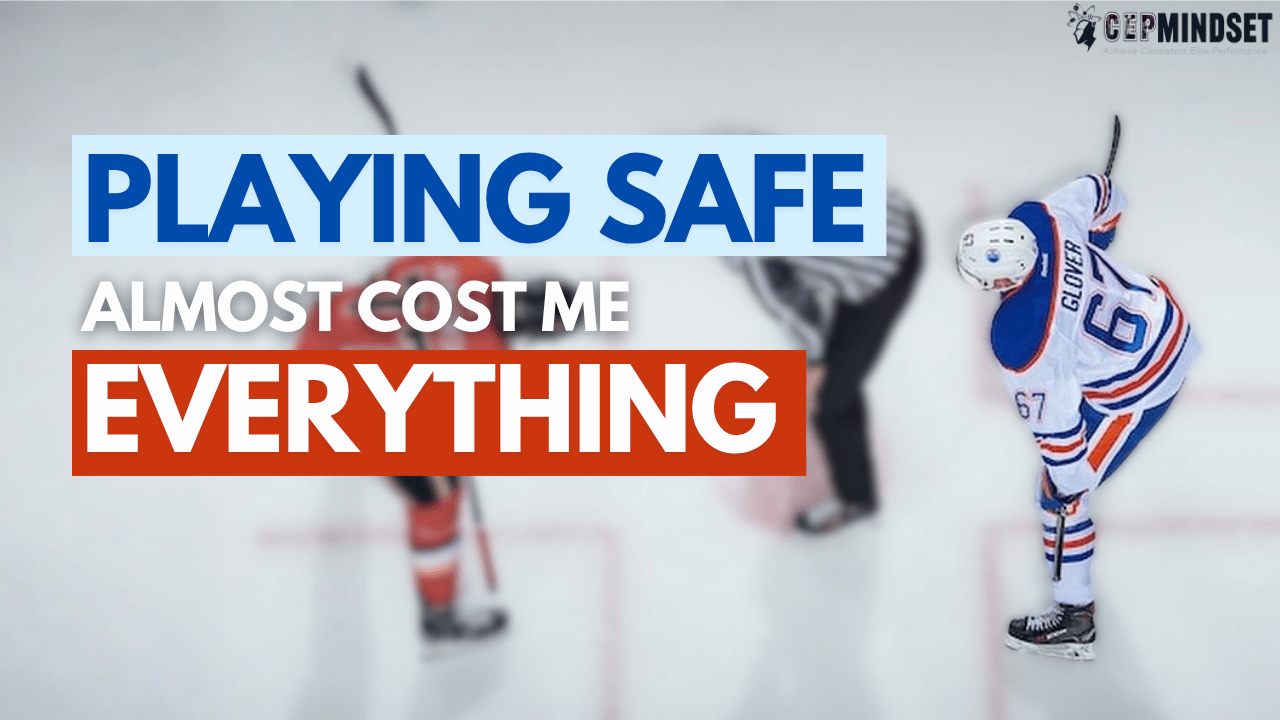
The game was tied 1-1 when Abby Murphy – a powerhouse on the US national team – broke away. Mari made the save, but then the ref called for a penalty shot.
Murphy scored, and celebrated with a dab, right in front of Mari.
It went viral. All over BarDown, Snapchat – every corner of her feed for days.
Overcoming the Worry of What Other People Think
Before we started working together, Mari’s mindset was almost entirely results-driven. One bad moment could send her into a full spiral. So when the dab video hit her feed and stayed there, it should have been devastating.
Instead, it became a turning point.
“It kind of humbles you and makes you realize – who cares? The worst could happen, and you survive.”
Getting scored on, going viral, watching strangers replay her worst moment online – none of it ended her career. It just proved the outcome she’d been dreading for years wasn’t actually the thing to fear.
Make Your Reset Routine Become Second Nature
Early on, Mari didn’t have a real reset routine. Over time, it became something she leans on constantly – in games, in practice, multiple times a day.
That routine was crucial during the Minnesota game.
Similarly, her reset routine got tested at the 2022 U18 World Championships. Mari wasn’t even supposed to play – she was the backup. But after the team lost to Finland for the first time ever and got outscored 7-0 by the Americans, she got put in mid-tournament and stayed in net through the semis and final.
In the gold medal game, her team went up 3-0 – then gave up two goals in under 30 seconds.
“Talk about having to use a reset routine.”
She held it. They won 3-2 and she was named MVP.
Hearing What She Needed, Not What She Wanted
Six years of working together changed how Mari communicates, not just how she plays. She pointed to honesty as the foundation.
“Sometimes you’re telling me not exactly what I want to hear, but what I need to hear – and I think that’s really important with a coach.”
She also came to see her development as two separate tracks: physical and mental. The physical side gets all the attention – ice time, gym work, things you can see. But she realized she could have all the physical tools in the world and still struggle to translate them under pressure. Working on the mental side was what let her actually use everything she’d built physically.
The Takeaway
Mari’s story is a reminder that the mental game is about proving to yourself you can handle the worst-case scenarios. Behind a gold medal and an MVP is a goalie who once froze before games. Behind that transformation is a reset routine, a coach willing to say hard things, and a willingness to let the results go.
As she put it herself – these tools didn’t just help her in hockey:
“They’ve helped me in hockey, in school, in friendships, and elsewhere. It’s more applicable than just your sport.”
Want to build your own mental game? Take a page out of Mari’s playbook:
- Let go of the outcome – you’ll survive the worst case
- Build a reset routine before you need one
- Let your coach tell you what you need to hear, not what you want to hear
- Trust that the mental side compounds – same as the physical
This blog was written by Coach Cassidy.
 Blair has over 13 years of experience as a Professional Dancer, Assistant Dance Captain & Cast Manager, as well as an additional 17 years of training. Over the last 3 decades, she has lived and experienced first hand the highest of highs & lowest of lows that come with pursuing a career in the Performing Arts.


 As a former member of McMaster University’s women’s soccer team, Emilie intimately understands the demands and challenges athletes face on and off the field. Although she encountered many challenges as a high-level athlete, particularly struggling with self-doubt and overthinking, Emilie was able to make a remarkable transformation when she began to embrace the principles of sports psychology.







 Danielle Hanus, MA
 Monica Russell, MA