Have you ever been about to play a big game and think “ahhh don’t screw it up!”
The pressure hits and you feel small — scared to make a mistake, hesitant to go for it, and second guessing yourself.
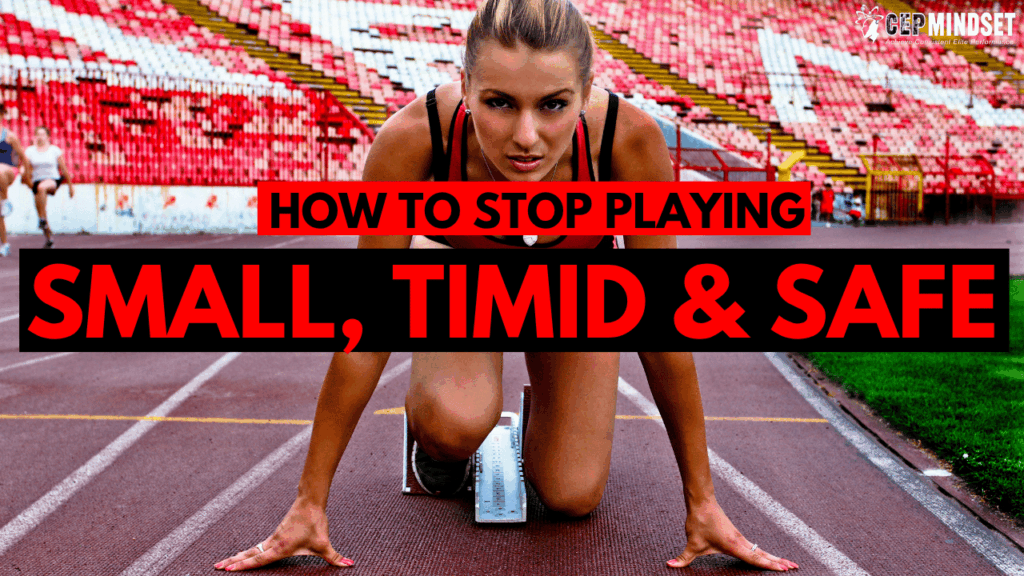
This is a typical response to pressure. The crippling fear of failure leaves athletes to play small, timid and safe.
However, it doesn’t have to be this way. Here is how I coach athletes to stop playing small, timid, and safe.
Step 1: Self-Compassion
When you catch yourself feeling small, timid, or safe — the first thing you need to do is not judge yourself and panic.
Think of it this way: you are already feeling small — you start to beat yourself up and panic for how you feel, then you are only going to feel smaller and more scared…
You can’t fight with yourself to get out of this feeling.
Instead, self-compassion is the key. Remind yourself that this is normal. Of course you don’t want to screw up, make mistakes, or lose. It would be weird if you didn’t have this feeling.
All it means is that you care and you don’t want to fail.
It’s just a feeling and you can move through it if you embrace it and see it for what it is. Don’t make the feeling bigger than it is.
Step 2: Own the Situation
Now that you are not in a downward spiral of self-judgement you need to make sure you own the situation. This means instead of resisting the pressure and range of results, you own it.
Often athletes will make the game bigger than it is. It feels all consuming. Paralyzing the athlete from tackling the game head on.
But it’s just a game. Don’t make the moment bigger than it is. If you can’t own the range of results, then maybe you shouldn’t be playing.
That’s the beauty of sports — we don’t know what is going to happen. But we can prepare the best we can, own the situation, and go after what we want. Then the result will be what it will be.
This is about shifting the narrative in our head from a threat focus “wow this game matters so much, I better not screw up” to an opportunity or gratitude focus “wow am I grateful I get to play this game, what an opportunity to have an impact!”
Once you have made this shift you stop feeling timid about the moment and start to feel a “bring it on” mentality.
Step 3: Get Big & Get Going
The final step is to actually physically make yourself big. If you don’t want to feel small, timid and safe, then shift your body into a big, powerful, and attack mode stance.
You will want to take big strong diaphragmatic breaths. Get on your toes. Lean forward. Get ready to pounce!
If you don’t have an Alter Ego — this is a great time to tap into this exercise.
This is about intentionally moving into the mindset you want at this moment.
For clients I’ll draw up as something like this:
Small, Timid, Safe -> Big, Attack Mode, Bring It On
The color coding actually further engrains the distinction from where you are to where you are going. I’m feeling yellow cautious to green go time!
Plan to Cope with Pressure
What you just did by reading and thinking about the above 3 steps was planning to cope with pressure.
Although reading it once is helpful. If you want to optimize the probability of responding to pressure this way the next time it hits, then you will want to rehearse this over and over again.
By investing the time reviewing your plan to cope with pressure you are preparing yourself to effectively respond when the time comes. This is not something you do once in a while. It should be part of your daily mental prep.
I want my clients to literally rehearse in their mind — if I feel Small, Timid, Safe then:
- Self-Compassion —- normalize, it’s okay
- Own the Situation — it’s just a game and it’s a great opportunity
- Get Big & Get Going — strong breaths, lean forward, bring it on
Some days doing the plan to cope doesn’t help because they don’t feel the pressure. But the days when the pressure hits they are ready and know how to respond.
The more they clarify their response, personalize it, and practice it — the more reliable they get.
That’s how you stop playing small, timid and safe.
This blog was written by Coach Cassidy.
 Blair has over 13 years of experience as a Professional Dancer, Assistant Dance Captain & Cast Manager, as well as an additional 17 years of training. Over the last 3 decades, she has lived and experienced first hand the highest of highs & lowest of lows that come with pursuing a career in the Performing Arts.


 As a former member of McMaster University’s women’s soccer team, Emilie intimately understands the demands and challenges athletes face on and off the field. Although she encountered many challenges as a high-level athlete, particularly struggling with self-doubt and overthinking, Emilie was able to make a remarkable transformation when she began to embrace the principles of sports psychology.







 Danielle Hanus, MA
 Monica Russell, MA