
The mental game is about aligning your thoughts, feelings and actions so you can achieve peak performance.
The problem is the concepts and strategies to work on the mental game are not tangible.
And the cliche advice is often fluffy and cookie-cutter. Not delivering reliable results.
So many athletes can get lost going down the rabbit hole working on all these mental strategies and trying to sort out what works and what doesn’t. Which often leaves athletes overwhelmed and more confused than when they started.
But that is why we, at CEP Mindset, use practical and personalized strategies. We don’t want the mental game to be confusing. It should be simple and powerful.
Cue the Mental Game Cheat Sheet — a simple, practical and personalized document we share with our 1-on-1 clients.
Below I’ve outlined the key framework for you. There are 3 main phases, each with a different mental mode required to excel at the mental game.
Phase 1: Preparation Mode
This is where you do all the thinking and you set your intentions for how you want to show up. The most energy goes into this phase. If you are not mentally prepared, then you are not going to excel in phase 2.
Preparation doesn’t mean you set goals and visualization success. Rather the keys to effective mental preparation are:
- Origin Story
A strategy that reconnects you to why you love the game in the first place. It’s not a list of what you love about the game. Rather it is a story and personal memory that evokes the feelings you want to stay connected to. Although the context has changed since you first started playing, the core feelings generally remain true. This exercise is an essential for optimizing motivation and keeping a healthy perspective.
- Coping Planning
You need to know how you plan to cope with pressure, adversity, and distractions. This is key to responding effectively during the game. By being aware of your ‘mental traps’ — what throws you off (e.g., missing a shot, facing a tough opponent) — you can then prepare for how you will respond. This improves your ability to regulate your emotions and stay dialed in throughout the game.
- Tangible Pillars (Action Planning)
Similar to coping planning, you want to prepare for how you plan to perform. Not just the actions and movements but, more importantly, how you want to feel while you perform them. I refer to these as tangible pillars for my clients. Because this is where they get to define what their game looks like and feels like when they are out there performing. These are the core traits or characteristics you want to embody during competition. They help you activate your Alter Ego.
These are the core intentions you need to be mentally prepared. It takes some time and energy to clarify and personalize these intentions. But the reward is worth it.
This is your game plan.
And it should be both simple and powerful. It needs to have the depth and nuance that is personalized to you. As well as having the simplicity and practicality that can easily be integrated into your pre-practice and pre-game routines.
Visualization is the best strategy to integrate these intentions into your practice and game day routines. It should incorporate your origin story, coping planning, and tangible pillars. Effective visualization generally lasts only 5-10 minutes.
The mental rehearsal primes your brain, makes your intentions vivid, and prepares you for performance mode.
Phase 2: Performance Mode
Now it’s time to turn your brain off and just play.
This has the least ‘instructions’ on the cheat sheet. If we do phase 1 effectively, then all the athlete needs to do in phase 2 is stop thinking and just trust their training.
Here are a few key concepts that help athletes do just that:
- Let Go & Let It Happen
The main goal of performance modes is to be in a state of trust. A deeper way of understanding that is the concept of letting go and letting it happen. In short it’s about not trying to ‘control’ everything and instead focus on what you can control and do your best to influence the game vs control. For more on this specific topic check out the ‘Fall Off the Cliff’ blog and analogy.
- Self-Compassion
When you are in performance mode you can’t be judgemental. If you start beating yourself up for every mistake or you get frustrated with yourself because your mindset is not ‘perfect’ — this is sure fire way to get into a downward spiral and not play free. The time for self-judgement is in phase 3. So if you catch yourself going down that path, the antidote is self-compassion. Remember that you are human and you will make mistakes and have emotions — that self-compassion is key so you can let it go and get back to trusting yourself (letting it happen).
- Adaptable
Since we can’t perfectly predict how everything will go, make sure you are willing and ready to be adaptable. This means a mentality of “I can handle anything” and or “bring it on!” It doesn’t mean we want to be doing a lot of thinking or judging during the game, but of course sometimes surprises come up, the context changes, or things aren’t going to plan — embracing the power of adaptability is key to staying in the moment.
Although I wrote a fair bit for each of those points — the concepts are pretty simple. And you do not need to be thinking of them during the game. Rather I put them here as reminders — they are subtle but key concepts to staying in the moment.
We don’t want athletes to think about their thinking during the game. Instead, we want your head in the game focused on the task at hand.
Of course, distractions will come up and you will need to reset. Hence, we have only 1 strategy for athletes to use during the game: The Reset Routine.
There can be many variations of this routine but generally it’s a personalized routine that takes about 10-15 seconds to complete. It helps you clear the noise (applying the coping planning from phase 1), brings you back to the present with deep breathing, then sets your intentions back on the task at hand — reactivating your alter ego. Check out the link above to learn more.
Phase 3: Reflection Mode
Once the practice or game has ended, it’s now time to self-assess. This is where you can judge yourself — especially your mindset and process more so than the results.
This phase is key to the learning cycle, building confidence, and separating your sport from other areas of life. Here are a few keys to optimizing phase 3:
- Own Your Wins
I can’t stress enough the importance of reviewing what went well. No matter how the practice or game went. If you want to be a high-performer that operates with confidence, then owning the progress you are making is key. We are naturally wired to focus on what went wrong and how to do better — this is our survival instinct. But the pursuit of high-performance is not about surviving, it’s about thriving. And the key to thriving is confidence. So owning your wins daily ensures you are building that internal momentum.
- Breakdown Your Mindset & Process
Most reflections prioritize results. This is incredibly flawed. Take the time to review how you did on your coping planning and tangible pillars. Separate the process from the results and take a critical lens to what works and what you could do differently. Although we are being more judgemental in this phase, be like a scientist that is curious and looking to understand and learn. Not chasing perfection and constantly beating yourself up for every mistake.
- Park It and Move On
Don’t carry the game with you for hours on end or days after. Wrap up your thoughts. Be satisfied with giving it the attention it deserves and processing it effectively. If old enough, we want our athletes writing their reflections down. This way you can come back and further reflect if needed. And you have a paper trail — which can help point to trends. Writing down your reflections helps you park it and move on to other areas of your life.
This shouldn’t take a long time. A solid 5-15 minutes of reflection is more than enough time.
Instead of following society’s definition of success. You create your own definition of success.
The strategy we use to optimize phase 3 is called the Personal Scorecard. It is all about being intentional with how you want to reflect. Don’t fall into the common mistakes of:
- Superficial reflections focused primarily on the results.
- Inconsistent reflections depending on how the game went.
- Only reflecting after games, missing the opportunities to grow from practices.
- Parents do the majority of reflecting with youth athletes — see parent expectations blog.
This isn’t about chasing perfection—it’s about showing up, stacking days, and letting consistency build confidence.
Putting It All Together: Your One Pager
The beauty of the Mental Game Cheat Sheet is its simplicity—it condenses your mental game into a single, actionable page. Follow the above phase and personalize your mental game cheat sheet. Some of my clients use the one-pager, while others have 1 page for each of the phases. Here is what a one-pager could look like:
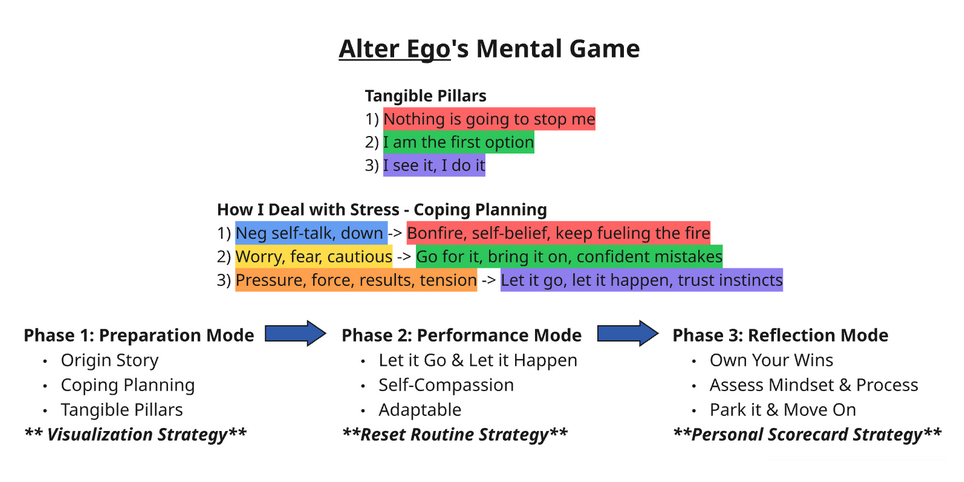
Once you have a solid and personalized mental game – the trick is to stay engaged with it daily.
Make sure to keep it accessible – take a screenshot, save it on your phone, or print it out. Review it consistently and refine it over time.
This one-pager is your mental game playbook. It’s a reminder of who you are, how you want to play, and how to stay grounded no matter what the game throws at you.
How Consistent Can You Be?
Creating your own personalized mental game cheat sheet is a massive separator. But to take your game to another level you have to engage with it daily.
We challenge our athletes to see how big of a streak they can set by following the 3 phases — effectively engaging in all 3 modes daily.
If you have practices and games that combine to 5 total events per week then the goal is to go 5 for 5 every week.
Can you do this for 1 week? What about 1 month? Let alone a full season?
Following the 3 phases some of the times will help improve your game. But the compound effect of doing it day-in and day-out is the key.
When you only engage in it some of the time, then the habit will eventually slip. And your engagement will continue to decrease over time.
Of course, we want our athletes to consistently perform at their capabilities — that is what the CEP in CEP Mindset stands for: Consistent Elite Performance.
And of course, we want our athletes to consistently play with confidence and in the zone. This is something we track and constantly reflect on.
But the real traction comes from following these 3 phases. Which is why I’m making the argument – this is the most important part of the mental game. Follow these 3 phases and watch as your mental game goes in an upward spiral.
Final Thoughts
Lastly, I want to highlight that although the mental game cheat sheet and these 3 phases are meant to be simple in theory. The reality of consolidating and working through them does take time and effort.
As Albert Einstein said “Genius is making complex ideas simple.”
So you can’t take short cuts. You have to do the work. But by engaging in the work above, you can get to a place of simplicity and power.
That’s what we specialize in at CEP Mindset — helping athletes just like you personalize practical strategies so you can have a simple yet powerful mental game.
Share this with anyone you think would benefit. And reach out if you are interested in learning more about our 1-on-1 Mental Performance Coaching Programs.
This blog was written by Coach Cassidy.

 Blair has over 13 years of experience as a Professional Dancer, Assistant Dance Captain & Cast Manager, as well as an additional 17 years of training. Over the last 3 decades, she has lived and experienced first hand the highest of highs & lowest of lows that come with pursuing a career in the Performing Arts.


 As a former member of McMaster University’s women’s soccer team, Emilie intimately understands the demands and challenges athletes face on and off the field. Although she encountered many challenges as a high-level athlete, particularly struggling with self-doubt and overthinking, Emilie was able to make a remarkable transformation when she began to embrace the principles of sports psychology.








 Danielle Hanus, MA
 Monica Russell, MA