Confidence is the most sought-after mental state in sport. But most athletes struggle to find it and keep it.
Here’s what most people get wrong: they’re chasing the wrong thing.
I want to redefine what confidence actually is — and give you a practical way to build it that doesn’t fall apart under pressure.
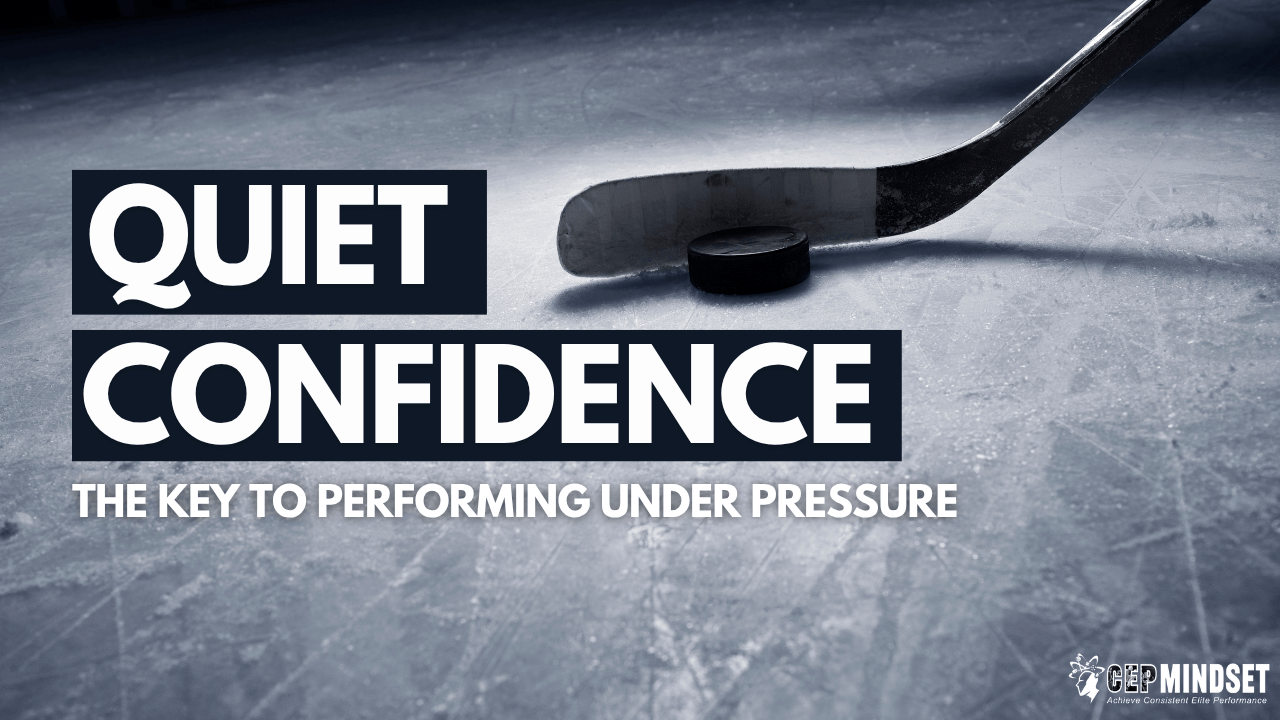
Let me introduce you to: Quiet Confidence.
The Problem With ‘Traditional’ Confidence
Most athletes experience what I call yo-yo confidence. When results are coming and people are praising you, confidence is high. When results dry up and criticism rolls in, confidence disappears. Sound familiar?
This is because confidence for most people is primarily associated with the external world. We picture ‘confident’ people as loud and boisterous. Their chest is out, they talk a big game, and can come across as arrogant.
But deep down, we all know this is not what true confidence is.
What is Quiet Confidence?
Think of it as a fire burning inside you. A bonfire. But it’s on the inside — only you know it’s there. Only you can feel it. Others might sense it through your body language, your composure, the way you carry yourself. But they’re guessing. You know.
That internal fire doesn’t rise and fall with results. It burns steadily — because it’s not fueled by what’s happening around you. It’s fueled by how you’ve prepared.
You think of it with this simple formula:
External preparation + internal preparation = Quiet Confidence.
External preparation is essential. The more physically, technically, and tactically prepared you are, the more confident you’ll feel going in. Study more for the exam, you feel more confident and less worried about how you will do. Put in the reps, you trust your body more on game day.
But this is where most elite athletes stop. They build an incredible external game — and leave their confidence entirely in the hands of results. So when things go sideways (and at some point, they always do), their confidence goes with it.
That’s why we need internal preparation.
If external preparation fuels our inner fire and belief in our capabilities, internal preparation is what protects the fire. It enables us to be resilient in the face of adversity and stay composed when under extreme pressures to perform.
F1 Racing Analogy
Think of it this way: external preparation builds the F1 car — the speed, the power, the precision. Elite athletes have an incredible car.
But internal preparation is the driver — the focus, composure, the ability to read and react in real time.
A great car with a great driver? That’s Quiet Confidence.
Apply It Now
So if your confidence has ever felt like it’s on a yo-yo — high when things are going well, gone the second they’re not — you don’t have a confidence problem. You’ve just been going about building confidence the wrong way.
Stop letting results be the thing that decides how confident you feel.
Instead, build your Quiet Confidence by owning the external work you’ve already put in. And prepare your mind to handle whatever comes your way.
And remember, quiet confidence is an internal feeling — and you know you have built it, when you have an unwavering sense that you are prepared and ready to perform.
This blog was written by Coach Cassidy.
 Blair has over 13 years of experience as a Professional Dancer, Assistant Dance Captain & Cast Manager, as well as an additional 17 years of training. Over the last 3 decades, she has lived and experienced first hand the highest of highs & lowest of lows that come with pursuing a career in the Performing Arts.


 As a former member of McMaster University’s women’s soccer team, Emilie intimately understands the demands and challenges athletes face on and off the field. Although she encountered many challenges as a high-level athlete, particularly struggling with self-doubt and overthinking, Emilie was able to make a remarkable transformation when she began to embrace the principles of sports psychology.








 Danielle Hanus, MA
 Monica Russell, MA