When you want something so bad, the hardest thing to do can be to let go and play free.
You feel the need to perform, to win, to prove yourself.
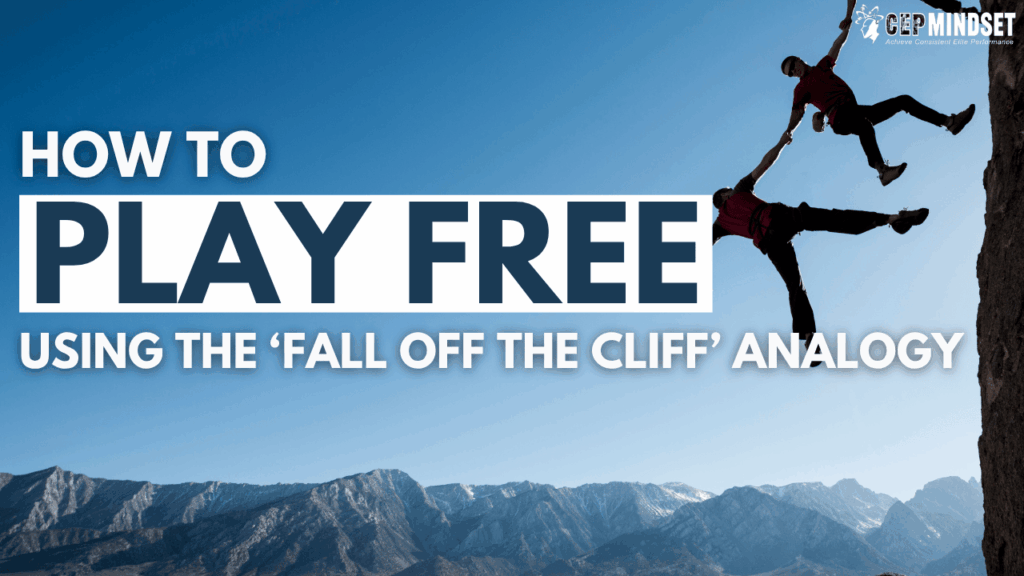
It is like you’re holding onto a rope at the edge of a cliff and you are terrified to let go.
You can’t accept failure. You need to be perfect. You need to control the outcome.
But what if letting go was the key to unlocking your best performance?
The Falling Off the Cliff analogy comes from Phil Stutz’s work on acceptance and it has been a game changer for my clients.
Let’s dive into this powerful tool and show you how to let go so you can play free.
The Cliff Analogy: Embrace the Free Fall
Picture yourself standing on a cliff before a big game. The game is the free fall—a leap into the unknown where you’ll either land where you want (a win, a great performance) or somewhere else (a loss, a mistake). There is a full range of outcomes, and you can’t control them all. The key? Let go of the rope and enjoy the fall.
- Holding On: When you feel the pressure to need a result (e.g., “I have to play well to impress the coach”), you cling to the rope. You try to control every move, force outcomes, and chase perfection. This tense, overthinking mindset makes you less likely to perform at your best.
- Letting Go: Letting go doesn’t mean giving up—it means trusting your preparation and embracing the fall. You accept that you can’t control everything, but you can influence the journey. You play free, stay present, and instead of forcing it, you let it happen.
The paradox? Trying to control your way to success often backfires, while letting go increases your chances of landing where you want—because you just trust your training and play free.
Shift from Control to Influence
You know when you have let go. You have the feeling of being free — you are in the free fall. But now you need to stay free and trust your training.
The mistake is going back to control. Trying to control how you play. Forcing yourself to feel a certain way or be perfect in how you show up.
This is why we need to shift from control to influence.
You influence the results based on how well you prepare and how well you can stay in the moment and trust your training.
This is where the “Let It Happen” part of the analogy kicks in. As you free fall you let yourself flow through the air, glide toward the desired landing area, and influence the end result. But you don’t fully control it. You can’t force yourself to get to a certain area. You can’t control the wind or other factors that might help or hinder the possible result.
This powerful 1-2 punch of “Let It Go” and “Let It Happen” is what the cliff analogy is all about.
Don’t Judge Till You Land
The last piece of the puzzle is what to do once the game is over. You have landed – maybe you like the results or maybe you don’t. Either way, it’s time to reflect.
A key lesson here is making sure not to get into this judgement and reflection mode before the game ends. This is a common mistake. So make sure you don’t write the game report before it’s over.
Similarly if you are someone who finds them consistently judging and trying to control yourself to be perfect — read the Scientist vs Performer Mindset Blog. The short of it:
- The Performer — they use the “Let It Go” and “Let It Happen” so they can stay in the moment and go with the flow.
- The Scientist — they are going to overthink, judge, and try to control the results. Not optimal for your performance as an athlete.
However, it is still important to reflect after practices and games. Importantly, make sure to own your wins and what you did well. This is key to ensure you own your capabilities and build internal momentum — a foundation to playing with consistent confidence.
Once you own your wins then it’s time to analyze, break the game down, and learn from it. But make sure you don’t stay in this ‘Scientist’ mode forever.
The cycle starts over again:
- Get back to the top of the cliff — prepare, set your intention, and “Let Go.”
- Influence during the free fall, not control — ie “Let it Happen.”
- Once it’s over — time to reflect, own your wins, and learn.
Can You Force Yourself to Let Go?
Every client eventually falls into the trap of trying to force themselves to let go so they can play and increase their probability of achieving the desired results.
The problem is if you let go with the purpose of trying to achieve something. Did you really let go?
The answer is NO!
It’s like letting go of the rope with one hand, but then quickly grabbing it with the other.
So although “Letting Go” and “Letting It Happen” will increase your probability of achieving the desired results, you can’t do it for that reason.
Which begs the question — why do you want to “Let Go” and play free?
The answer…
Well, you don’t even need to verbalize it or find the words. You need to feel the answer.
And it will likely have something to do with the love of the game. It’s fun to play free, to play your game, and just surrender yourself to the experience.
Many of my clients like to talk about how they are proud of how they showed up more so than what they achieve.
Think about the cliff analogy.
Are you jumping off the cliff to achieve a result or because you like to cliff dive?
It’s the experience of free falling, the journey, or the game itself.
This is one of the hardest lessons to learn in sports. And it’s why having a system in how you prepare and reflect is crucial so you don’t get sucked into the allure of results.
Reset Routine Application
This analogy works wonders with one of our fundamental strategies: The Reset Routine. The 3 steps are to:
A – Accept: which is “Let Go”
B – Breathe: keeps you relaxed and in the moment
C – Commit: which is “Let It Happen”
The analogy can help free up athletes that struggle to play free. They try to force themselves to accept the range of results and commit to their game in a controlling manner. Which is obviously not optimal.
So by switching acceptance with “Let Go” and commitment with “Let It Happen” it creates a much more relaxed and freeing approach.
Next Steps
You’ve trained your body and sharpened your skills—now it’s time to free your mind.
Stop gripping the rope. Let go, embrace the free fall, and play with the confidence that comes from trusting your preparation and accepting the range of outcomes.
Start by visualizing the cliff before your next practice or game. See yourself letting go, falling freely, and influencing the journey with intention, not control.
“Let Go” and “Let It Happen.”
This blog was written by Coach Cassidy.
 Blair has over 13 years of experience as a Professional Dancer, Assistant Dance Captain & Cast Manager, as well as an additional 17 years of training. Over the last 3 decades, she has lived and experienced first hand the highest of highs & lowest of lows that come with pursuing a career in the Performing Arts.


 As a former member of McMaster University’s women’s soccer team, Emilie intimately understands the demands and challenges athletes face on and off the field. Although she encountered many challenges as a high-level athlete, particularly struggling with self-doubt and overthinking, Emilie was able to make a remarkable transformation when she began to embrace the principles of sports psychology.








 Danielle Hanus, MA
 Monica Russell, MA